East Meets West: The Architecture of Longevity
By Kenneth Bordewick | Beverly Hills Luxury Interiors | ÖND | Life's Breath™ · In clinical collaboration with Dr. Thom Lobe MD and Dr. Fouad I. Ghaly MD
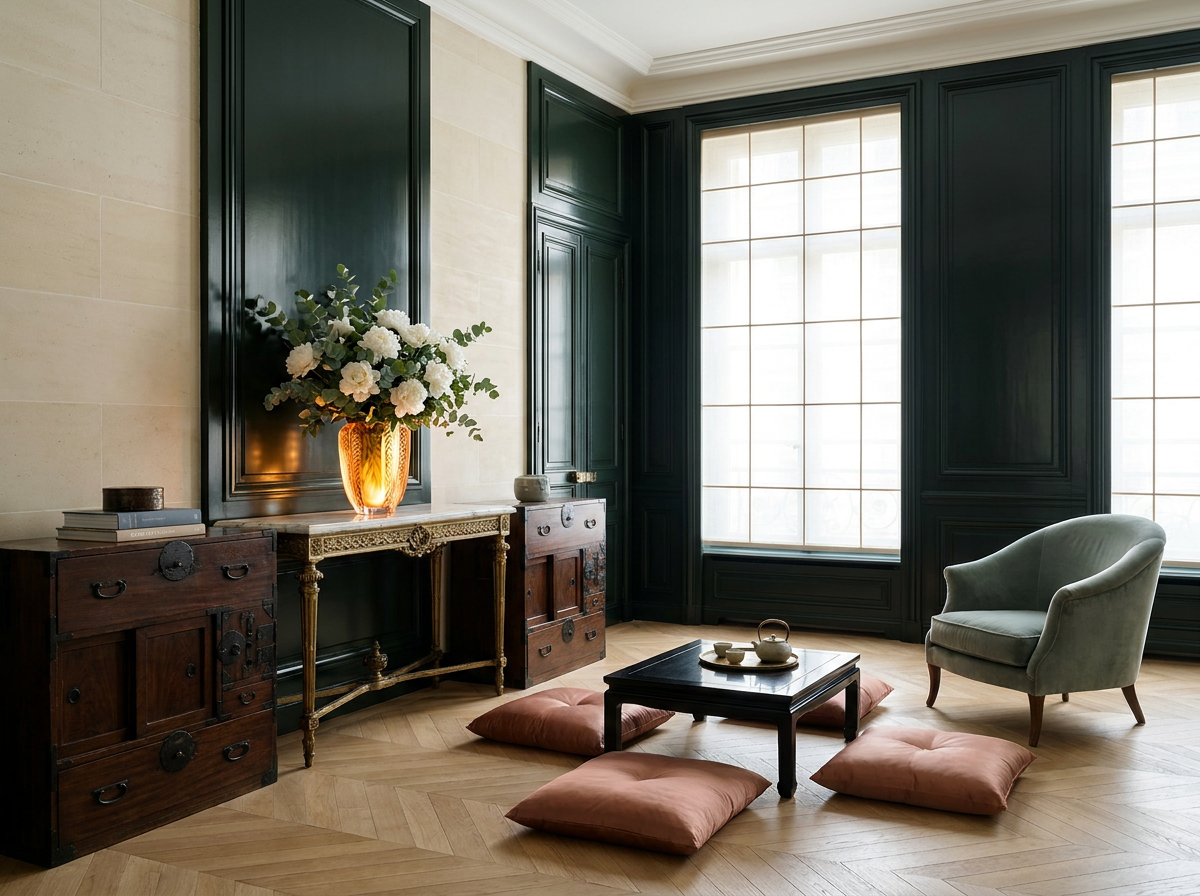
In 2024, researchers confirmed what the healer-architects of three ancient civilisations had been prescribing for three thousand years: the built environment governs human gene expression. Not metaphorically. Molecularly. Research published in Nature Reviews Genetics established that environmental factors — the light falling on the retina, the air entering the lungs, the materials in daily contact with the skin — account for the dominant share of gene expression variation across a human lifetime. Your genes, it transpires, are not your destiny. Your home is.
This is the foundational premise of Kenneth Bordewick's East-meets-West design philosophy — the integrated framework that underpins every commission undertaken by Beverly Hills Luxury Interiors and every ÖND | Life's Breath™ residence created in partnership with clinical collaborators Dr. Thom Lobe MD and Dr. Fouad I. Ghaly MD. It is a philosophy not born of fashionable eclecticism, but of rigorous observation: that Eastern and Western healing science, when examined without cultural bias, are not divergent traditions. They are the same prescription, expressed in different vocabularies.
Vastu Shastra: The World's First Epigenetic Architecture
Vastu Shastra — the ancient Indian science of built environments, codified in the Brihat Samhita some two thousand years ago — reads, in retrospect, as a remarkably precise epigenetic intervention manual.
Its prescriptions are specific: orient the primary sleeping space towards the south or east to maximise morning solar exposure. Ensure the movement of natural light across living spaces transitions from high-intensity morning illumination to reduced evening luminance. Specify only natural, elemental materials — stone, hardwood, cotton, clay — in all surfaces in prolonged contact with the body. Maintain unobstructed airflow from external sources through principal occupied spaces. Incorporate water — moving, clean, and audible — into the inhabited interior environment.
Each of these prescriptions has been confirmed in molecular terms by the clinical research of the past two decades. Morning solar exposure entrains the hypothalamic-pituitary-adrenal axis, setting the cortisol gradient that governs energy, cognition, and immune function across the entire day (Nobel Prize in Physiology or Medicine, 2017). Natural materials eliminate the VOC off-gassing, microplastic shedding, and phthalate release that synthetic finishes introduce into the atmospheric environment. Whole-home filtration of water removes the chlorine, chloramines, and microplastic particulates that municipal supply delivers with every glass and every shower.
Vastu did not understand these mechanisms. It did not need to. It observed, across centuries of population-level evidence, that homes built to this specification produced inhabitants of measurably greater vitality and longevity. The mechanism was irrelevant to the prescription.
Traditional Chinese Medicine: Qi, Wu Xing, and the Biology of Flow
Traditional Chinese Medicine's residential design science — feng shui, the management of qi flow through inhabited space — addresses the same biological environment through a different conceptual lens. The concept of qi — vital life force — is, at its most clinically translatable, a description of the measurable biological conditions that support cellular function: electromagnetic coherence, atmospheric quality, thermal equilibrium, acoustic serenity, and the absence of chemical burden.
The Wu Xing — the Five Phase theory of Wood, Fire, Earth, Metal, and Water — prescribes precise elemental balances within the interior. Excessive Metal, in the TCM residential framework, corresponds to the over-specification of synthetic composite materials, rigid forms, and harsh acoustic surfaces — conditions now understood by environmental medicine to elevate cortisol through continuous low-level sensory stress. The prescription of balanced Wood — natural grain, living botanicals, organic curves — addresses, in contemporary terms, the biophilic design principles that peer-reviewed research in environmental psychology has confirmed to reduce cortisol, lower blood pressure, and improve sleep architecture.
The TCM injunction against blue-spectrum artificial light in sleeping and contemplative spaces was not, in its original formulation, a reference to LED technology. It was an observation about the quality of fire — the ancient elemental principle governing light and transformation — and its appropriate role in the hours of rest. Nobel Prize-winning circadian biology now confirms the molecular mechanism with extraordinary precision: blue-spectrum light suppresses melatonin synthesis and disrupts the cellular repair processes that occur exclusively during deep slow-wave sleep.
“The luxury home of the twenty-first century is not a debate between Eastern and Western aesthetics. It is a synthesis of both traditions — and when that synthesis is executed with clinical precision, the result is not merely a beautiful space. It is a living, breathing instrument of health.”
— Kenneth Bordewick, Beverly Hills Luxury Interiors
The Western Confirmation: What Epigenetics Changes
The emergence of epigenetics as a discipline has not merely validated the premises of Eastern healing science — it has transformed the basis upon which the luxury residential environment must be justified.
Prior to the widespread understanding of gene expression and environmental modulation, the case for a biologically optimised home rested on the cumulative burden of toxicological and epidemiological evidence. Individual compounds — formaldehyde, benzene, phthalates, chlorine byproducts — could each be linked to specific adverse health outcomes. The case was compelling. But it was, ultimately, additive: a series of individual harms to be individually eliminated.
Epigenetics changes the frame entirely. It establishes that the built environment is not merely a source of discrete hazards. It is a continuous signal — an environmental communication reaching every cell in the body, via light receptors, olfactory pathways, skin contact, pulmonary absorption, and gastrointestinal intake — that either supports or undermines the expression of the genetic potential every individual carries. A home designed with clinical precision does not merely reduce harm. It actively modulates gene expression in the direction of vitality, cellular repair, and extended healthspan.
This is precisely what vastu shastra and TCM prescribed, without the vocabulary of molecular biology, for three thousand years. And it is the foundation of the ÖND | Life's Breath™ design methodology.
The BHLI East-meets-West Framework in Practice
At Beverly Hills Luxury Interiors, the East-meets-West framework translates into a precise clinical design specification — not a philosophical orientation. It is the integration of vastu-informed spatial orientation and material specification with TCM-aligned elemental balance and light management, validated against and refined by the clinical frameworks of Dr. Thom Lobe MD and Dr. Fouad I. Ghaly MD.
In material terms: every surface in prolonged body contact is specified from natural, zero-off-gassing sources — stone, hardwood, hand-applied mineral plaster, natural fibre textiles. In atmospheric terms: H14-grade HEPA filtration combined with activated carbon removes both particulate and VOC burden. In light terms: tunable circadian LED systems are calibrated to replicate the natural solar arc, from high-intensity morning illumination to restorative amber in the hours preceding sleep. In water terms: multi-stage whole-home filtration eliminates pharmaceutical residues, chlorine, and microplastic particulates at the point of entry.
Each specification corresponds simultaneously to a vastu or TCM prescription and to a specific, peer-reviewed clinical outcome. This is not coincidence. It is the convergence that occurs when two traditions — separated by three thousand years and the width of a continent — are both attempting to describe the same biological truth. Explore the full wellness design principles that guide every Beverly Hills Luxury Interiors commission.
The Home as Medicine: A Three-Thousand-Year Prescription
The most consequential clinical decision a person of means makes is not which supplements to take, which physician to retain, or which blood filtration protocol to commission. It is the residential environment in which every other decision is undermined or sustained.
Three ancient traditions — Ayurvedic vastu shastra, Traditional Chinese Medicine, and the Hippocratic environmental medicine of the classical West — each arrived, without consultation or shared scholarship, at the same conclusion. Your home is either healing you or harming you. And the difference is entirely by design.
The most advanced Western molecular biology has now confirmed this. And Beverly Hills Luxury Interiors has been building to this standard — in Beverly Hills, Manhattan, London, the Persian Gulf, and across every international atelier commission — for more than a quarter century.
Commission Your Longevity Home Wellness Design Audit
The Longevity Home Wellness Design Audit, conducted by Beverly Hills Luxury Interiors | ÖND | Life's Breath™ in clinical collaboration with Dr. Thom Lobe MD and Dr. Fouad I. Ghaly MD, assesses your current residential environment against the integrated East-meets-West standard — evaluating material purity, atmospheric quality, circadian light architecture, water integrity, acoustic design, and thermal precision. Each domain is benchmarked against the convergent prescriptions of vastu shastra, Traditional Chinese Medicine, and contemporary longevity medicine, delivering a prioritised design roadmap with optional physician consultation.
Enquire About Your AuditSources: Brihat Samhita (Vastu Shastra classical text, c. 500 CE). | Huangdi Neijing (Yellow Emperor's Classic of Internal Medicine, c. 200 BCE). | Hindorff LA, et al. “Potential etiologic and functional implications of genome-wide association loci for human diseases and traits.” PNAS, 2009. | Feil R, Fraga MF. “Epigenetics and the environment: emerging patterns and implications.” Nature Reviews Genetics, 2012. | Nobel Prize in Physiology or Medicine 2017 — circadian rhythm mechanisms (Hall, Rosbash, Young). | World Health Organisation. WHO Guidelines for Indoor Air Quality, 2010. | Newmark PA, et al. “Microplastics and cardiovascular risk.” New England Journal of Medicine, 2024. | Kaplan S. “The restorative benefits of nature.” Journal of Environmental Psychology, 1995. | Reference: Dr. Thom E. Lobe MD, Beneveda Medical Group. | Reference: Dr. Fouad I. Ghaly MD. | Beverly Hills Luxury Interiors | ÖND | Life's Breath™