Four Senses Your Luxury Home Has Never Addressed
By Kenneth Bordewick | Beverly Hills Luxury Interiors | ÖND | Life's Breath™ · In clinical collaboration with Dr. Thom Lobe MD and Dr. Fouad I. Ghaly MD
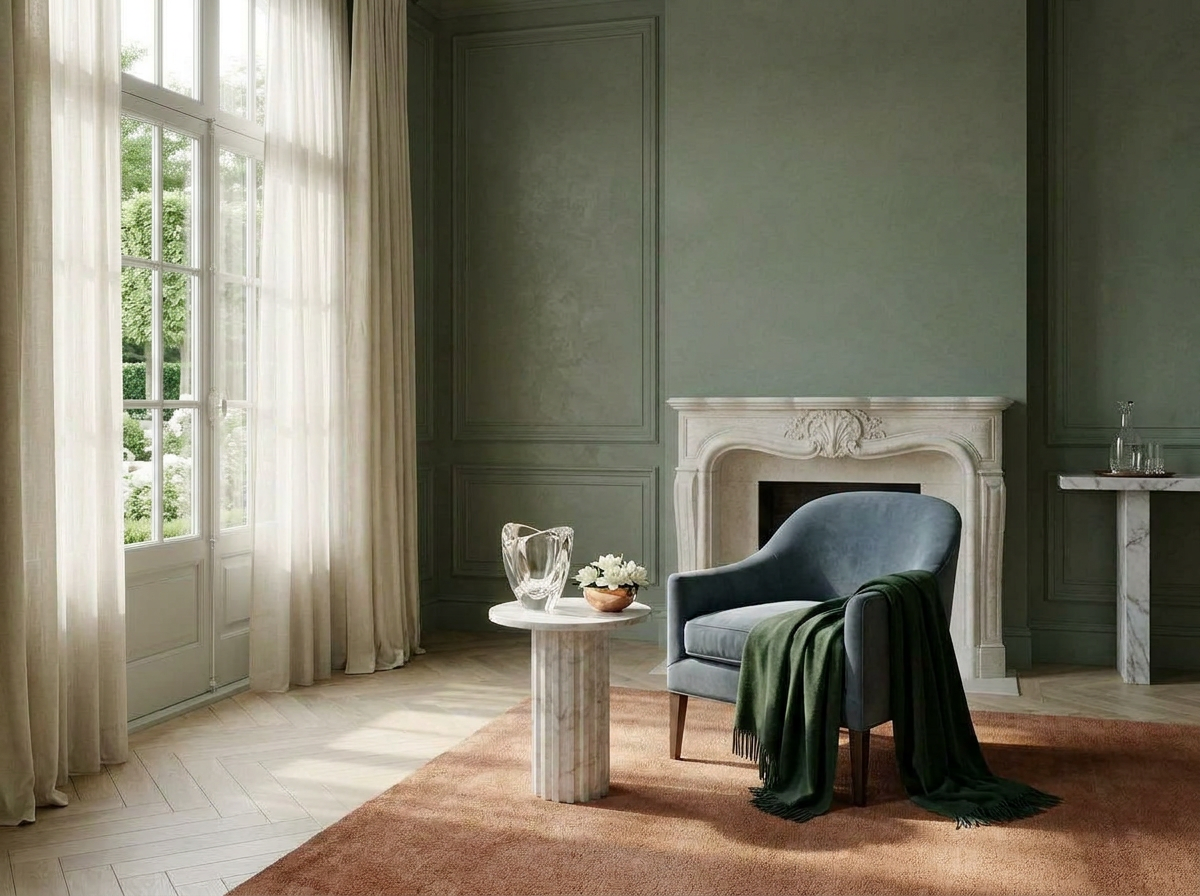
A thirty-million-pound residence may score a perfect ten on sight and an absolute zero on the four senses that actually govern your health. This is not a deficiency of budget. It is a deficiency of design philosophy — and it is the defining limitation of luxury interiors as the discipline is currently practised.
Interior design, in its conventional form, is an exercise in visual composition. Palette, proportion, material, light — all orchestrated to produce rooms that satisfy the eye. This is not without merit. The eye is the most culturally dominant of the senses, and a well-composed space communicates refinement, authority, and considered taste with immediate force.
But you do not inhabit a photograph. You inhabit a biological environment. Your nervous system does not evaluate your home through its camera; it evaluates it through four additional channels — sound, touch, smell, and taste — that operate below the threshold of conscious aesthetics, and that have been found, in a growing body of clinical literature, to be among the most consequential determinants of long-term health and longevity.
At Beverly Hills Luxury Interiors, Kenneth Bordewick has spent more than 25 years designing for all five. Guided by our clinical partners Dr. Thom Lobe MD and Dr. Fouad I. Ghaly MD, and through the integrated methodology of ÖND | Life's Breath™, we treat the sensory environment not as a hierarchy with sight at its apex, but as five equally weighted domains of biological design — each of which demands the same precision, rigour, and material intelligence.
What follows is an account of the four senses that most luxury homes have never seriously addressed — and what it takes to design for them properly.
The First Neglected Sense: Sound
Acoustic design is the discipline most frequently omitted from even the most expensive residential commissions. Its absence is rarely visible — which is precisely why it persists. A room can be acoustically inadequate and still photograph beautifully.
The consequences, however, are not invisible. Research published in Noise & Health (Basner et al., 2014) confirms that chronic low-level sound exposure during sleep — including ambient urban noise transmitted through inadequately specified glazing — elevates nocturnal cortisol, fragments sleep architecture, and prevents the sustained slow-wave sleep during which cellular repair occurs. The World Health Organisation estimates that over one million healthy life-years are lost annually across Western Europe alone due to traffic-related noise, with residential settings accounting for a significant proportion of that burden.
A Beverly Hills Luxury Interiors commission addresses this through acoustic-grade cavity insulation, mass-loaded vinyl decoupling between floor plates, laminated glazing specified to an attenuation rating appropriate for the location, and soft furnishings selected as much for their sound-absorption coefficients as their visual character. Target ambient noise levels in sleeping quarters: below 30 decibels. That figure is not a luxury enhancement. It is the clinical minimum for restorative sleep.
“Silence is not an absence. It is a designed condition — the rarest and most valuable quality in the modern residential environment.”
— Kenneth Bordewick
The Second Neglected Sense: Touch
Every surface in your home is in constant tactile communication with your body. This is not metaphorical. Thermal conductivity, surface texture, hardness, and material density are all continuously registered by the somatosensory nervous system — and all of them carry biological information that influences the perception of safety, comfort, and ease within a space.
Natural materials — stone, solid timber, handwoven linen, unfinished lime plaster — have a thermal and tactile warmth that the nervous system interprets as biologically familiar. Their synthetic counterparts register as inert, or subtly foreign. This distinction is not merely aesthetic preference. It is a physiological response encoded across millions of years of evolutionary adaptation to natural environments.
There is a further dimension to material selection that extends beyond the purely tactile. Many synthetic surfaces off-gas volatile organic compounds — formaldehyde, benzene, and phthalates among them — that accumulate within the sealed thermal envelopes that modern energy efficiency standards now require. At Beverly Hills Luxury Interiors, material purity is a clinical specification: zero-VOC finishes, natural stone, solid hardwood, and natural plaster as standards, not options. The surface you touch must not require your body to mount a chemical defence against it.
The Third Neglected Sense: Smell
The olfactory system is unique among the senses in the directness of its neurological connection. Where sight, sound, and touch are mediated by relay stations in the thalamus before reaching the cortex, smell connects directly to the limbic system — the brain's emotional and hormonal centre — with a speed and immediacy that no other sense can match. This is why a single scent can alter mood within seconds, and why indoor air quality is not merely a comfort variable but a neurochemical one.
The United States Environmental Protection Agency estimates that indoor air may be two to five times more polluted than outdoor air in major urban environments. Particulate matter, VOCs, mould spores, and — as recent research confirms — microplastic fibres circulate invisibly through poorly ventilated spaces, entering the respiratory system with every breath.
Our olfactory and air specification addresses this at three levels: material selection (eliminating synthetic off-gassing sources), active filtration (H14-grade HEPA with activated carbon for VOC capture), and biological scent introduction (beeswax candles, natural botanical diffusion, dried florals) — providing only compounds that the body recognises as safe. The result is an environment that does not merely smell pleasant, but that supports the neurological and immunological functions governed by the olfactory-limbic pathway.
The Fourth Neglected Sense: Taste
That taste belongs in a conversation about interior design is, to many designers, a foreign proposition. Yet Dr. Fouad I. Ghaly MD characterises residential water quality as among the most consequential — and most overlooked — variables in the clinical design of a longevity environment.
Microplastics have been detected in 100 per cent of human blood samples tested in recent peer-reviewed research (Leslie Ryan et al., Environment International, 2022). Municipal water supplies routinely contain chlorine, chloramines, pharmaceutical residues, and microplastic particulates. A household that spends significant resource on organic food and advanced nutritional supplementation — and then hydrates from an unfiltered tap — is creating a clinical contradiction that undermines every other investment in its own longevity.
Our water specification integrates whole-home multi-stage filtration at the point of entry, reverse osmosis at drinking and cooking sources, remineralisation to restore the trace mineral content stripped by filtration, and copper, glass, or stainless-steel pipework throughout — because microplastic particulates shed from standard plastic plumbing into the water stream at every point of contact. This is not a specification tier reserved for the highest-value commissions. In a Beverly Hills Luxury Interiors residence, it is the minimum.
The Fifth Sense: Sight — and Its Proper Role
None of the above diminishes the importance of sight. Visual design is the language through which a home communicates its values — its restraint, its generosity, its relationship to beauty and proportion. The Quiet Luxury Framework practised at Beverly Hills Luxury Interiors is, among other things, a rigorous visual discipline: the elimination of excess, the elevation of material quality, the pursuit of rooms that achieve their effect through confidence rather than volume.
But sight, addressed in isolation, produces spaces that perform beautifully in photographs and fail the body over time. The aspiration — and the standard — is a home that serves all five senses with equal intelligence. A home where the acoustic environment supports deep sleep, where every material serves both eye and body, where the air promotes neurological clarity, and where the water is as considered as the wine.
This is the standard that defines a Beverly Hills Luxury Interiors commission. It is also, we believe, the only standard worthy of a life that is genuinely well-lived.
Commission Your Longevity Home Wellness Design Audit
The Longevity Home Wellness Design Audit, conducted by Beverly Hills Luxury Interiors, assesses your home's sensory environment across all five dimensions: sight, sound, touch, smell, and taste. Each domain is evaluated against clinical and design standards, delivering a prioritised report and phased design roadmap — with optional consultation from our physician partners, Dr. Thom Lobe MD and Dr. Fouad I. Ghaly MD. To enquire, contact the atelier.
Enquire About Your AuditSources: Basner, M. et al. “Auditory and non-auditory effects of noise on health.” Noise & Health, 2014. | World Health Organisation. Environmental Noise Guidelines for the European Region. WHO Regional Office for Europe, 2018. | U.S. Environmental Protection Agency. “Indoor Air Quality.” EPA.gov, 2023. | Leslie Ryan et al. “Detection of microplastics in human blood.” Environment International, 2022. | Reference: Dr. Thom E. Lobe MD — regenerative and longevity medicine, physician partner, Beverly Hills Luxury Interiors. | Reference: Dr. Fouad I. Ghaly MD — integrative longevity and environmental medicine, physician partner, Beverly Hills Luxury Interiors. | Beverly Hills Luxury Interiors | ÖND | Life's Breath™