Microplastics: The Invisible Invasion at Home
By Kenneth Bordewick | Beverly Hills Luxury Interiors | ÖND | Life's Breath™ · In clinical collaboration with Dr. Thom Lobe MD and Dr. Fouad I. Ghaly MD
Peer-reviewed research has now confirmed microplastic particles in human blood, lung tissue, placentas, and brain matter. These fragments — shed invisibly by synthetic textiles, engineered flooring, acrylic lacquers, and composite cabinetry — enter the body through inhalation and dermal absorption, hour by hour, day by day, within the very environment designed to provide sanctuary. The most dangerous contaminants in the modern luxury home have no colour, no scent, and no visible form. And yet they accumulate — in the bloodstream, the soft tissue, the cellular machinery — with a persistence that no supplement, no protocol, and no intervention can fully remediate while the exposure continues unabated.
The question that Kenneth Bordewick, founder of Beverly Hills Luxury Interiors, poses to every prospective client is one that the industry has long been unwilling to ask: where, precisely, are these particles entering your body? The answer, for individuals inhabiting luxury residences designed by conventional means, is almost invariably the interior environment itself.
The Interior as Vector
The luxury home — designed to be a sanctuary — may, without the application of rigorous biological intelligence, become one of the primary vectors for microplastic exposure in the modern world. Synthetic textiles release fibres with every disturbance. Engineered flooring systems shed nano-particles with every footfall. Polyurethane lacquers on custom cabinetry decompose at the molecular level, releasing particles too small to be visible and too numerous to be avoided. Foam-filled upholstery, treated wall coverings, and acrylic-sealed plasterboard contribute their own chemical profiles to the atmospheric burden.
This is not a failure of intent. It is a failure of discourse. The interior design industry has historically specified materials for their visual excellence, their structural performance, and their cost. The biological consequence of those materials — their microplastic-shedding profiles, their VOC emissions, their endocrine-disrupting potential — has existed almost entirely outside the professional conversation. Until now.
“The question is not whether your home is beautiful. The question is whether it is honest — honest in its materials, its air, and its biological consequences for the life being lived within it.”
— Kenneth Bordewick, Beverly Hills Luxury Interiors
What Microplastics Do Inside the Body
The Clinical Picture
The emerging research landscape is unambiguous in its direction, if not yet complete in its conclusions. Microplastic particles, once absorbed, are associated with inflammatory responses in endothelial tissue, oxidative stress, mitochondrial dysfunction, and disruption of the gut microbiome. In arterial tissue, their presence has been linked in peer-reviewed literature to significantly elevated cardiovascular risk. In neurological samples, their detection raises questions about long-term cognitive health that responsible medicine — and responsible design — cannot defer.
Dr. Thom Lobe MD, a pioneer in integrative and anti-ageing medicine whose clinical collaboration with Kenneth Bordewick has shaped the BHLI longevity design methodology, describes the cumulative body burden of environmental toxins — of which microplastics form an increasingly dominant component — as one of the most consequential and least acknowledged factors in premature biological ageing. The clinical protocols his practice employs to address this burden are, without exception, more effective when the home environment is no longer contributing to it.
Dr. Fouad I. Ghaly MD, whose integrative practice addresses the intersection of environment, lifestyle, and biological longevity, offers the same clinical perspective with different vocabulary: the home is a pharmacological environment. It administers its chemistry to the occupant's biology with every breath and every hour. The only variable is whether that chemistry has been chosen with intelligence.
The quiet luxury wellness design framework employed by Beverly Hills Luxury Interiors exists precisely to ensure that the answer is yes.
The BHLI Material Philosophy
Material Honesty as Design Principle
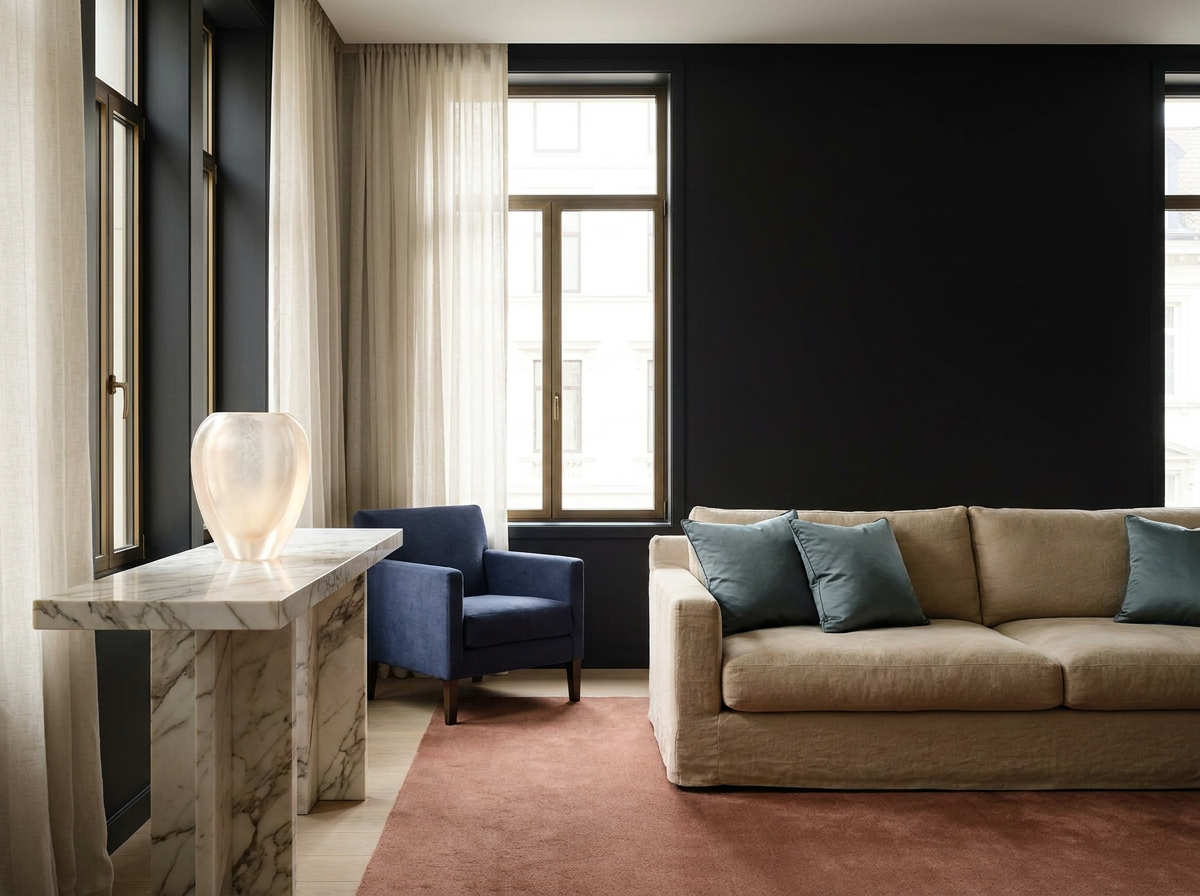
The BHLI approach to microplastic elimination begins with what Kenneth Bordewick calls material honesty. Stone is stone — natural, honed, biologically inert. Timber is correctly specified, kiln-dried, finished with non-synthetic oils and mineral waxes. Linen is linen — untreated, unwoven with polyester blends, sourced from natural fibres that carry no synthetic burden. Plaster is mineral. Leather is vegetable-tanned. Every decorative object is evaluated for its composition before its beauty.
The visual result of this discipline is the quiet luxury interior in its most authentic expression: spaces of extraordinary restraint, where the magnificence derives not from artifice but from the inherent beauty of materials selected with uncommon precision and installed with the finest available craftsmanship.
The biological result is measurable. When natural materials replace synthetic ones throughout a commission, the airborne microplastic load — and the associated VOC burden — falls to a fraction of what conventional luxury design produces. This outcome is not an aspiration. It is, at Beverly Hills Luxury Interiors, a minimum standard.
ÖND | Life's Breath™ and the Atmospheric Response
Material purity addresses what the home introduces into the atmosphere through its surfaces and substrates. ÖND | Life's Breath™ — Beverly Hills Luxury Interiors' proprietary clinical-grade atmospheric standard — addresses what remains: the fine particulates, biological aerosols, and residual chemical compounds that even the most carefully specified natural interior will inevitably accumulate.
The ÖND system delivers HEPA and activated carbon filtration in concert, precision humidity management within the therapeutic range of 45–55%, negative ion generation, and the complete elimination of synthetic fragrance and chemical aerosols from the domestic environment. In a home where both the material foundation and the atmospheric management have been governed by this standard, the air quality is measurably — clinically — superior to any conventionally designed residence, regardless of the sum invested.
The full framework governing these decisions is available at BHLI's wellness design principles.
The Paradox of the Expensive Home
There is a profound irony at the centre of contemporary luxury residential design. The client who has assembled the resources to inhabit one of the world's finest homes may, through no fault of their own and through the conventions of an industry that has never asked the biological question, be living within one of the world's most concentrated personal pollution environments.
The luxury is genuine. The materials are costly. The craftsmanship is evident in every detail. And yet, behind the lacquered panels, beneath the engineered flooring, above the acrylic-finished plasterboard, the chemistry of industrial production continues its patient, invisible work — shedding particles, particles, particles, into the sealed and climate-controlled air that the occupant's body must process, hour by hour, through every day of what was designed to be a long and magnificently lived life.
“A home that costs a fortune and quietly burdens the biology of the person within it is not a luxury home. It is an expensive one. The distinction matters more than any specification of marble or any calibration of light.”
— Kenneth Bordewick, Beverly Hills Luxury Interiors
Microplastics are invisible. Their biological consequences are not. The home that refuses to introduce them, and that actively removes what the modern world delivers to its threshold, represents a new — and, in the view of Beverly Hills Luxury Interiors, the only genuinely credible — definition of residential luxury.
Commission Your Longevity Home Wellness Design Audit
The Beverly Hills Luxury Interiors Longevity Home Wellness Design Audit is the most rigorous evaluation of residential biological quality available to the private client. Conducted personally by Kenneth Bordewick and the BHLI specialist team — in close collaboration with ÖND | Life's Breath™ and longevity clinicians Dr. Thom Lobe MD and Dr. Fouad I. Ghaly MD — the Audit delivers a comprehensive assessment of your existing or proposed interior environment across every dimension that matters: materials, air, light, water, acoustics, and electromagnetic environment.
It is the beginning of the most important design conversation you will ever have. The one that asks not how beautiful your home should be — but how biologically sovereign.
Beverly Hills Luxury Interiors does not administer medical treatments. All clinical protocols and longevity interventions should be discussed with a qualified physician — including Dr. Thom Lobe MD and Dr. Fouad I. Ghaly MD — before undertaking. All information in this article is educational in nature.