Microplastics: The Home You Cannot Afford to Ignore
By Kenneth Bordewick | Beverly Hills Luxury Interiors | ÖND | Life's Breath™ · In clinical collaboration with Dr. Thom Lobe MD and Dr. Fouad I. Ghaly MD
In 2024, researchers published a finding so consequential that every person who owns a home should have seen it as front-page news: microplastic particles were present in one hundred per cent of arterial plaques examined — and those patients carrying the highest concentrations faced a four-and-a-half times greater risk of heart attack, stroke, or death. Not elevated. Not incremental. Four and a half times. And the primary vector of exposure was not the ocean, not food packaging, not the air outside. It was the built interior environment.
The home you wake up in every morning. The rooms in which you sleep, breathe, dine, and recover. The floors beneath your feet and the finishes above your head. They are, in millions of residences across the world, a continuous, invisible, and cumulative source of microplastic contamination — operating without announcement, without permission, and without mercy.
At Beverly Hills Luxury Interiors, Kenneth Bordewick has spent more than two decades building a design philosophy that refuses to accept this as the price of modern living. The result — the ÖND | Life's Breath™ methodology — is a clinical and aesthetic framework that eliminates microplastic exposure at the source. Not through a single intervention. Through every choice in the room.
Explore the principles that guide this approach in our Quiet Luxury Wellness Design overview, and the biological rationale behind each decision at our Wellness Design Principles page.
Where the Particles Come From
Microplastics enter the domestic environment through routes that are entirely mundane, and for that reason almost entirely overlooked. Synthetic carpet fibres shed microscopic particles with every footfall. Polyester and nylon upholstery release a continuous particulate cloud with every movement. Painted walls containing synthetic binders off-gas fragments into the room. Composite timber panels — the staple of contemporary joinery — emit plastic-bonded adhesives over their entire service life. Plastic plumbing, plastic-coated wiring, synthetic ceiling tiles: these are the invisible infrastructure of the modern luxury interior.
Water compounds the exposure. Standard municipal supply contains measurable microplastic concentrations. Piped through plastic infrastructure — as the majority of domestic supply systems are — the particle load only increases at the point of consumption. Filtered through a conventional under-sink cartridge? The particles continue. The filter addresses minerals. It does not address a particle measured in microns.
“There is no such thing as an innocent material choice. Every surface in a room is a biological decision. The question is not whether the home has a microplastic problem. The question is whether its designer chose to address it.”
— Kenneth Bordewick
The consequence is not hypothetical. A 2022 study in Environment International detected microplastics in the lungs of living patients — all of them. A 2023 paper in Science of the Total Environment confirmed plastic particles in breast milk. The 2024 arterial plaque study, published in the New England Journal of Medicine, was the moment that rendered further equivocation untenable.
The Clinical Dimension
Our clinical collaborators — Dr. Thom Lobe MD and Dr. Fouad I. Ghaly MD — both practitioners at the leading edge of integrative and longevity medicine — have identified the interior environment as an underestimated variable in patient outcomes. Patients who invest significantly in advanced protocols, from blood filtration to peptide therapies to cellular regeneration, frequently return to homes in which the very stressors being addressed clinically are being continuously re-administered through the domestic environment.
It is, as Dr. Lobe has observed, the equivalent of prescribing a course of anti-inflammatory medicine to a patient whilst leaving the source of inflammation entirely undisturbed. The protocol may slow the damage. It cannot reverse it whilst the environment persists.
The ÖND | Life's Breath™ framework addresses this clinical reality by treating the home as an active participant in the patient's longevity protocol — not a passive backdrop to it.
The BHLI Material Purity Protocol
The elimination of microplastic exposure from a residential environment requires the systematic replacement of synthetic materials with natural, tested, and verified alternatives. This is not a luxury position. It is a biological one.
Natural Stone and Mineral Plaster
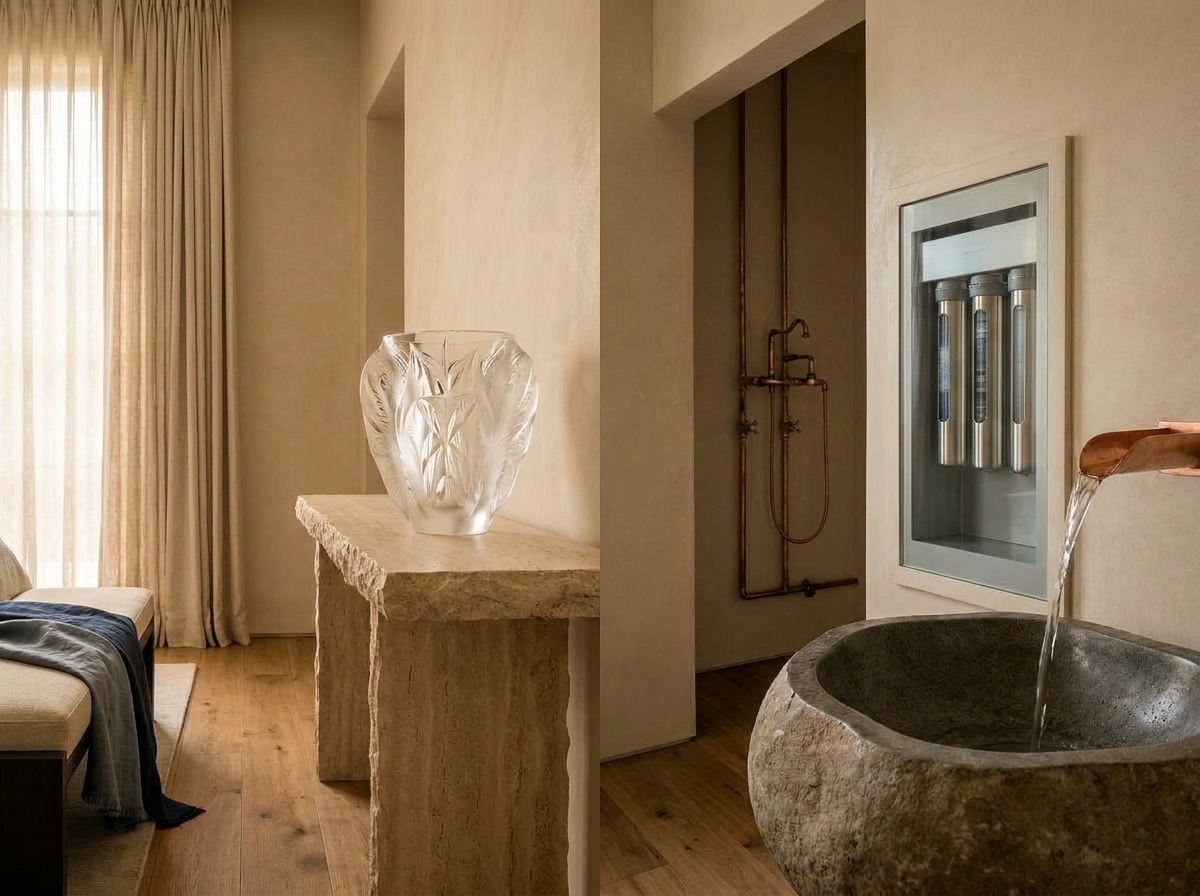
Where composite boards and synthetic renders dominate contemporary construction, the BHLI approach specifies natural limestone, travertine, and marble — quarried, not manufactured. Wall finishes are mineral plaster: lime, clay, or gypsum — materials that have existed in building for millennia and that the immune system has had equivalent time to recognise as biologically inert. No VOC off-gassing. No microplastic emission. No synthetic binders releasing particles into the air column across a twenty-year service life.
Hardwood, Wool, and Natural Fibre
Flooring is one of the most intensive microplastic sources in the domestic environment. Every step on synthetic carpet or luxury vinyl tile releases particles into the air. BHLI specifications default to untreated solid hardwood, natural stone, or organic wool area rugs — materials that wear without fragmenting into particulate clouds. Upholstery is specified in natural linen, untreated leather, and wool textiles. Curtains are hand-woven linen or heavy silk. No synthetic fibre. No compromises dressed as convenience.
Whole-Home Water Filtration
Water enters a BHLI residence through a multi-stage whole-home filtration system installed at the property boundary — not at the kitchen tap, but before the water reaches a single pipe, fitting, or surface within the home. Reverse osmosis at point-of-use removes sub-micron particulates. Hydrogen infusion stations restore the water's molecular structure and antioxidant properties. The result is water that is not merely safe by regulatory standards, but biologically advantageous by clinical ones.
H14-Grade Air Purification
The ÖND air purification system is specified at H14-grade HEPA — the standard used in operating theatres and pharmaceutical cleanrooms. Integrated architecturally, not placed as appliances, these systems operate continuously, removing particulates, biological agents, and microplastic fibres from the air column with a measured efficiency of 99.995 per cent. Combined with natural ventilation design — strategically placed operable sections that draw fresh air across plant filtration walls — the interior air quality of an ÖND-designed residence is, by any clinical measure, superior to outdoor ambient air in the locations these residences occupy.
The Luxury That Actually Costs You Nothing
There is a pervasive assumption in luxury design that natural materials are a compromise — that synthetic alternatives are the mark of modernity, of performance, of technical sophistication. It is one of the most consequential misapprehensions in the built environment.
Natural stone does not shed microplastics. Mineral plaster does not off-gas endocrine disruptors. Hardwood floors do not release synthetic polymer fibres into the air column. Organic wool textiles do not contaminate the lung tissue of the person who sleeps beneath them. These materials are not only more beautiful, more enduring, and more biologically honest than their synthetic counterparts. They are, over the lifetime of the home, more cost-effective — because they do not require the clinical remediation that a biologically hostile environment eventually generates.
The luxury home that does not address microplastics is not a luxury home. It is an expensive one. The distinction matters — more, perhaps, than any other in the design brief.
Begin Your Longevity Home Wellness Design Audit
Is your home silently depositing microplastics into your bloodstream? The Longevity Home Wellness Design Audit by Beverly Hills Luxury Interiors and ÖND | Life's Breath™ delivers a comprehensive, physician-informed assessment of your home's material environment — including microplastic exposure vectors, air and water quality, and a prioritised, phased roadmap for transformation.
Enquire About Your AuditSources: Marfella R et al. Microplastics and Nanoplastics in Atheromas and Cardiovascular Events. New England Journal of Medicine. 2024;390:900–910. | Jenner LC et al. Detection of microplastics in human lung tissue using μFTIR spectroscopy. Science of the Total Environment. 2022;831:154907. | Ragusa A et al. Plasticenta: First evidence of microplastics in human placenta. Environment International. 2021;146:106274. | Leslie HA et al. Discovery and quantification of plastic particle pollution in human blood. Environment International. 2022;163:107199. | Reference: Dr. Thom Lobe MD, Beneveda Medical Group, Beverly Hills. | Reference: Dr. Fouad I. Ghaly MD, Integrative Longevity Medicine.