Quiet Luxury Isn't Aesthetic. It's Neuroscience.
By Kenneth Bordewick | Beverly Hills Luxury Interiors | ÖND | Life's Breath™ · In clinical collaboration with Dr. Thom Lobe MD and Dr. Fouad I. Ghaly MD
Chronic exposure to visual and auditory complexity elevates cortisol by up to thirty per cent — and for the majority of ultra-high-net-worth individuals, the primary source of that complexity is not the workplace, not the commute, not the social calendar. It is the home itself.
This figure, corroborated in peer-reviewed research published in Psychoneuroendocrinology, carries a consequence that no amount of supplementation or clinical therapy can fully offset: the environment in which the world's most health-conscious individuals invest the most sleep, the most rest, and the most recovery is, in the majority of cases, actively working against them.
Quiet luxury is the design philosophy that corrects this. But it is not, as it is so frequently presented, a trend defined by neutral palettes and the absence of pattern. It is something more fundamental — a neurological response to the built environment, encoded in human biology over hundreds of thousands of years, and now being confirmed with increasing rigour by clinical research. Kenneth Bordewick of Beverly Hills Luxury Interiors and ÖND | Life's Breath™ has spent more than twenty-five years interrogating this relationship. The conclusion is unambiguous: a home that disturbs the nervous system is not a luxury home, regardless of the materials it contains. This is the design standard explored in full at Quiet Luxury Wellness Design and Wellness Design Principles.
The Cortisol Architecture of Most Luxury Homes
The cortisol architecture of most luxury homes is, in a clinical sense, broken.
Research has demonstrated that environments characterised by visual complexity — unresolved geometries, competing materials, the visual noise of excessive decoration and poorly considered scale — maintain the hypothalamic-pituitary-adrenal axis in a state of low-level activation. The body does not discriminate between the cortisol of a traffic emergency and the cortisol of a room that cannot quite be processed. It simply releases it — steadily, silently, across every waking hour spent within those walls.
The consequence, accumulated over years of daily exposure, is chronic sympathetic nervous system engagement in the one environment that should be its antithesis. This is not, as Dr. Thom Lobe MD — physician partner at Beverly Hills Luxury Interiors — has observed in clinical collaboration, a matter of aesthetics. It is a matter of physiology. Patients who present with adrenal dysregulation, disrupted sleep architecture, and the persistent diminishment of vitality that conventional medicine struggles to attribute to any single cause are, in a significant proportion of cases, living in environments that are maintaining their stress response twenty-four hours a day.
“A home that disturbs the nervous system is not a luxury home. It is merely an expensive one.”
— Kenneth Bordewick
What the Nervous System Demands from a Room
The human nervous system did not evolve in a showroom. It evolved in natural environments characterised by horizontal lines, organic materials, the sound of moving water, and the slow arc of natural light across stone and earth. When the built environment mirrors these characteristics — even at the level of detail, texture, and acoustic quality — the parasympathetic nervous system responds. Heart rate variability improves. Cortisol stabilises. The sense of biological safety that is the precondition of deep rest is restored.
This is the neuroscience that underpins the Quiet Luxury Framework at Beverly Hills Luxury Interiors. It is not a preference for restraint for its own sake. It is the recognition that restraint is the architectural vocabulary of the nervous system at rest — that what the body experiences as luxury and what the brain identifies as safety are, in the most neurologically coherent environments, the same thing.
The Three Neurological Principles of Quiet Luxury Design
I. Visual Coherence Over Visual Complexity
The visual cortex processes the entirety of a room before the conscious mind has formed an opinion. A space of visual coherence — where colour relationships are resolved, where materials speak a shared language, where scale and proportion honour the harmonic ratios that the brain finds inherently legible — registers as safe. The parasympathetic system activates. The body breathes.
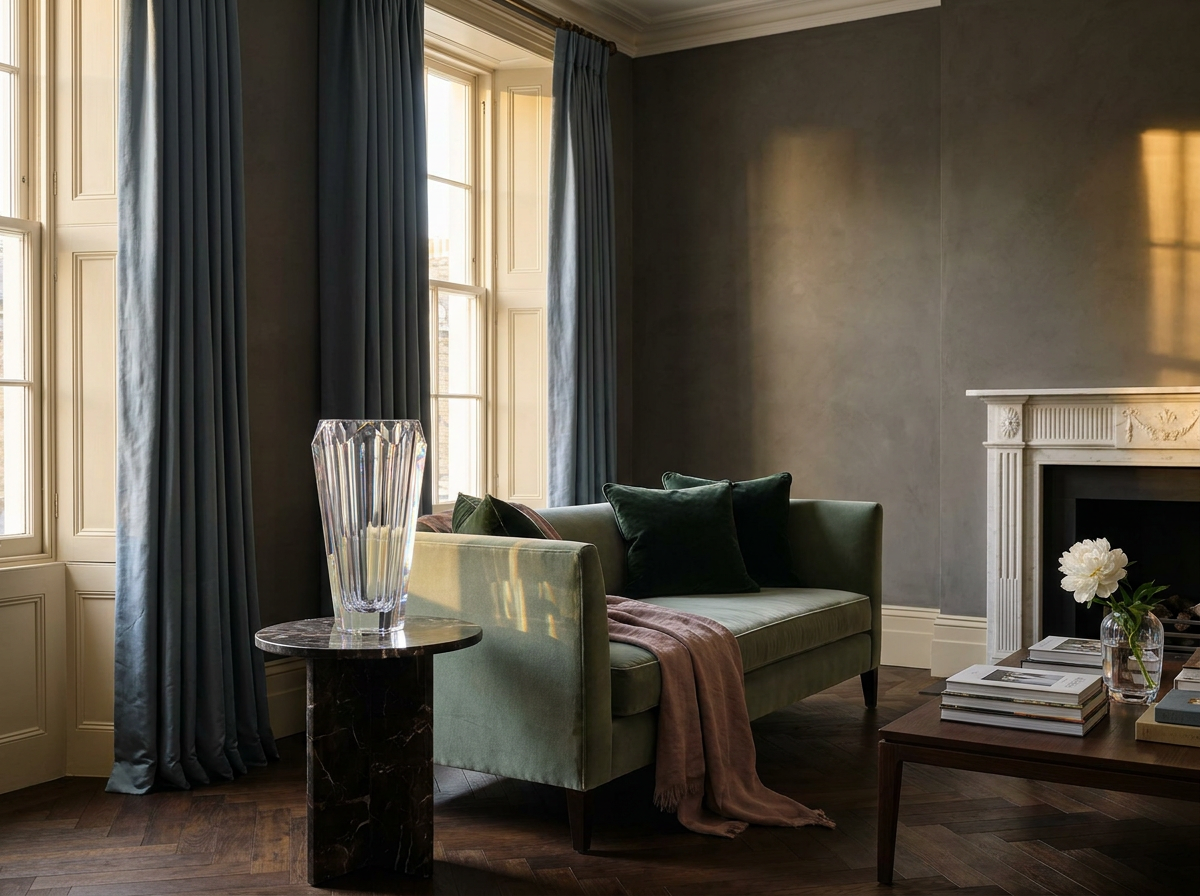
At Beverly Hills Luxury Interiors, every commission undergoes what Kenneth Bordewick terms the visual cortex test: standing at the threshold of a completed room and asking whether the body relaxes or quietly braces. Only the former is acceptable. Muted jewel tones — sage green, slate blue, dusty rose, deep forest green, warm charcoal — introduced with deliberation and restraint, achieve what an exclusively neutral palette cannot: a sense of considered life, of space inhabited with intention, of beauty that asks nothing of the nervous system in order to be experienced.
II. Acoustic Quietude as a Health Metric
Sound is the sensory input the body cannot screen. The eye may be closed; the ear is always open. And yet acoustic design remains, in most luxury interiors, an afterthought — a specification made at the margins of the brief rather than at its centre.
Research from University College London has linked chronic low-level noise — mechanical hum, structural resonance, the reflected acoustics of hard surfaces — to elevated nocturnal cortisol, reduced slow-wave sleep, and impaired cardiovascular recovery. In the Quiet Luxury Framework, acoustic serenity is treated as a health metric with the same seriousness as air quality or material toxicity. Hard surfaces are layered with natural fibre textiles. Mechanical systems are specified for acoustic performance. The architecture is designed to absorb. Dr. Fouad I. Ghaly MD has noted in clinical collaboration with Beverly Hills Luxury Interiors that clients who optimise their acoustic environment report measurable improvements in sleep quality within weeks — without any other intervention.
III. The Material Honesty That Touch Can Verify
The third principle is material purity — not merely aesthetic, but biological and neurological simultaneously. Natural stone, hardwood, linen, wool, silk: these are the materials that touch can trust. The hand that moves across unsealed marble or hand-woven linen receives a sensory signal of authenticity that the nervous system registers as safety. Synthetic alternatives — however convincingly rendered, however expensively finished — deliver a dissonance that the body measures even when the mind does not. Over time, this dissonance compounds. It contributes to the ambient sense of inauthenticity that characterises homes of great cost but insufficient intelligence.
Material honesty is, in this understanding, one of the most powerful instruments of the Quiet Luxury Framework — and one of the most consistently undervalued by luxury design practitioners who have never asked what the home is doing to the nervous system of the person within it.
Quiet Luxury as a Neurological Standard
The Quiet Luxury Framework, as developed by Kenneth Bordewick at Beverly Hills Luxury Interiors, is not the absence of decoration. It is the presence of neurological intention. Every decision — material, colour, acoustic, scale, proportion, light — is interrogated through the question that ancient design systems and modern neuroscience have arrived at by different roads: does this make the nervous system feel safe?
When the answer is yes — consistently, across every surface and every dimension of the interior — the result is a home that works without effort. A home that heals, rests, and restores without announcement. That is the definition of quiet luxury. And it is, in the most literal sense available to architecture, a form of medicine.
ÖND | Life's Breath™ was created to honour this understanding at the highest level of craft and clinical rigour — because the home that knows what it is doing to the nervous system is the only home worth commissioning.
Discover Your Home's Neurological Intelligence
The Longevity Home Wellness Design Audit delivers a comprehensive, physician-aligned assessment of your home's biological environment — including the neurological stressors most luxury interiors harbour — and provides a prioritised, actionable roadmap for transformation. Contact Beverly Hills Luxury Interiors to commission your audit.
Enquire About Your AuditSources: Marchand, L. et al. “Cortisol response to visual and acoustic environmental stressors.” Psychoneuroendocrinology, Vol. 45, 2014. | University College London: Environmental Noise and Health Research Programme. | Kaplan, R. and Kaplan, S. The Experience of Nature: A Psychological Perspective. Cambridge University Press, 1989. | Alvarsson, J.J. et al. “Stress Recovery during Exposure to Nature Sound and Environmental Noise.” International Journal of Environmental Research and Public Health, 7(3), 2010. | Reference: Dr. Thom Lobe MD, Beneveda Medical Group, Beverly Hills — regenerative and longevity medicine. | Reference: Dr. Fouad I. Ghaly MD — integrative longevity and environmental medicine.