Quiet Luxury: Where Design Becomes Medicine
By Kenneth Bordewick | Beverly Hills Luxury Interiors | ÖND | Life's Breath™ · In clinical collaboration with Dr. Thom Lobe MD and Dr. Fouad I. Ghaly MD
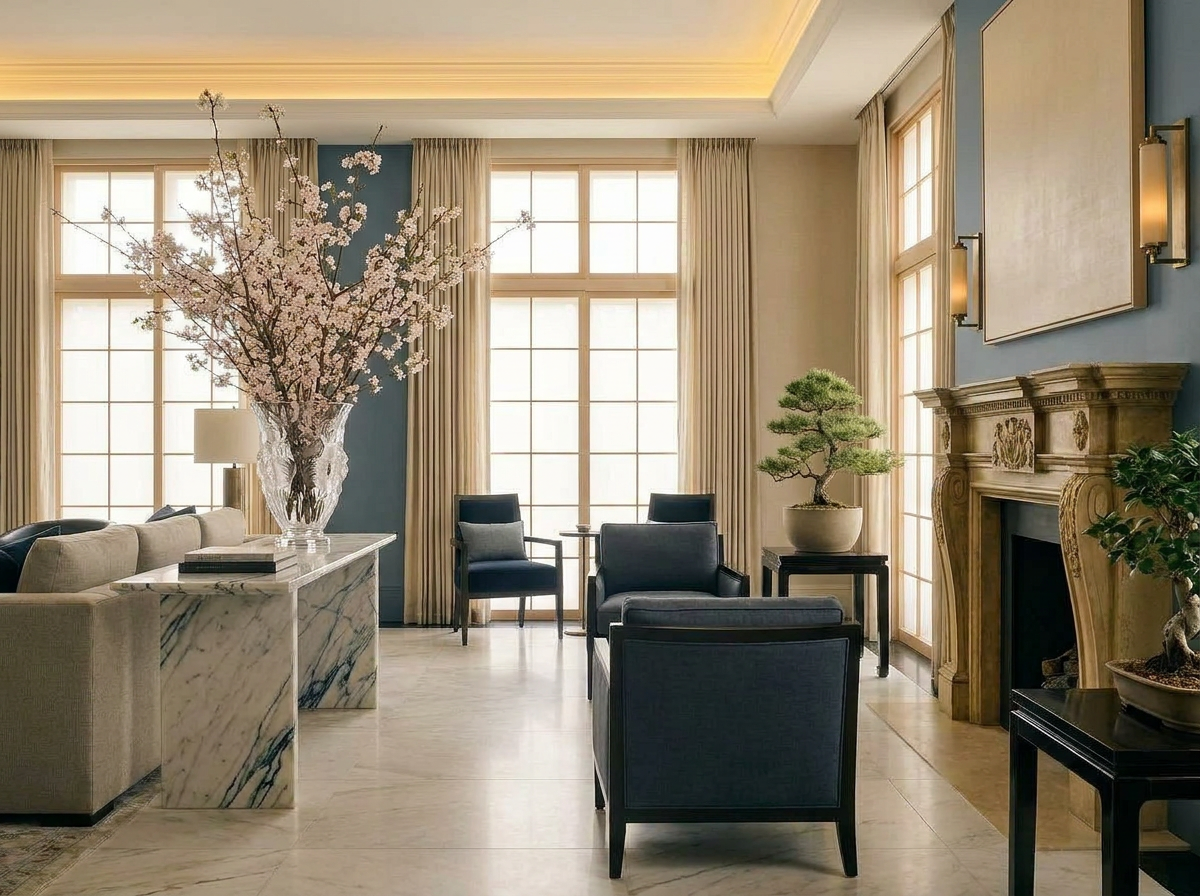
Ninety per cent of your life is spent indoors — and your home is either prescribing health or administering harm, without asking your permission. Not through any single dramatic exposure, but through the relentless accumulation of design decisions that most architects never pause to examine through a biological lens: the light spectrum at seven in the morning, the off-gassing of the bedroom ceiling, the electromagnetic field in which you spend eight hours of every night.
The extraordinary irony of modern luxury design is that its greatest achievements — its finest composite materials, its most sophisticated acoustic panels, its most prestigious synthetic textiles — are frequently the most biologically costly. Beauty and health have been treated as separate conversations. At Beverly Hills Luxury Interiors, Kenneth Bordewick has spent more than a quarter century insisting that they are one and the same.
That insistence has a name: Quiet Luxury. And it has consequences that reach far beyond aesthetics.
Explore the full framework in our Quiet Luxury Wellness Design approach, and the clinical principles behind it at our Wellness Design Principles page.
What Quiet Luxury Is Not
It is not a colour palette. It is not neutral walls and cashmere throws, however beautifully executed. It is not minimalism for minimalism's sake, nor restraint as a counter-reaction to the maximalism of the previous decade.
Quiet Luxury — as defined by the BHLI design philosophy — is the deliberate engineering of an environment in which the human nervous system is not under assault. It is the systematic removal of biological noise: visual complexity that elevates cortisol, synthetic materials that infiltrate the bloodstream, spectral light that undermines melatonin, electromagnetic interference that disrupts cellular repair, and acoustic environments that hold the autonomic nervous system in a state of low-grade vigilance it was never designed to sustain indefinitely.
“The finest room ever built is not the one that commands the most admiration upon entry. It is the one in which, after a week, you realise you are sleeping better, thinking more clearly, and carrying yourself differently.”
— Kenneth Bordewick
This is not philosophy. It is physiology. And the evidence for it has been accumulating in peer-reviewed literature for over two decades.
The Cortisol Architecture of a Home
Cortisol — the body's primary stress hormone — does not distinguish between a threatening encounter and a visually overstimulating room. Both register as demand. Both produce the same cascade: heightened alertness, elevated heart rate, suppressed digestion and immune function, and, over time, measurable acceleration of the cellular ageing process.
The average luxury interior, as it is conventionally conceived, is a cortisol-generating environment. Its surfaces demand appraisal. Its proportions compete for precedence. Its lighting changes nothing across the arc of the day. Its materials — however exquisitely chosen for their visual qualities — have not been selected with any consideration of what they emit into the air or discharge into the electromagnetic field.
Our clinical collaborators Dr. Thom Lobe MD and Dr. Fouad I. Ghaly MD, whose expertise in integrative and longevity medicine informs the ÖND | Life's Breath™ framework, have both noted the same clinical pattern: patients who undergo regenerative protocols — blood filtration, cellular repair therapies, hormonal recalibration — and then return to biologically hostile homes experience diminished and shorter-lived outcomes. The intervention is working; the environment is undoing it.
The Seven Pillars of Quiet Luxury Design
Every BHLI commission is evaluated against seven biological criteria, each of which corresponds to a dimension of human physiology that design directly influences.
I. Circadian Light Architecture
Light governs the body's hormonal rhythms with a precision no supplement can replicate. Blue-enriched, high-kelvin light in the morning drives cortisol and dopamine to their functional peaks. Amber and red spectra in the evening allow melatonin to rise unimpeded. A Quiet Luxury home mirrors this biological arc with tunable full-spectrum lighting systems — not as a technology showcase, but as invisible clinical infrastructure. Sleep quality improves by up to thirty per cent in properly aligned circadian environments. The impact on cognitive performance, inflammatory markers, and immune function is proportionately significant.
II. Material Purity
The body breathes the room it inhabits. Synthetic finishes, composite boards, formaldehyde-emitting adhesives, and treated textiles constitute a chronic, low-level toxic exposure that most occupants never attribute to their environment precisely because the symptoms — fatigue, disrupted sleep, inflammatory conditions — are so common as to be considered normal. Quiet Luxury design specifies natural stone, unprocessed hardwood, mineral plaster, organic fibre, and untreated leather: materials that do not off-gas, that do not shed microplastics, and that the body recognises, on a cellular level, as safe.
III. Acoustic Serenity
Sound reaches the amygdala before it reaches the cortex. The body evaluates acoustic environments for threat before the mind has the opportunity to interpret them as merely loud or merely busy. Rooms with excessive reverberation — hard surfaces, sharp frequencies, uncontrolled bass resonance — hold the nervous system in a state of mild alertness that is biologically indistinguishable from low-level stress. Acoustic serenity, achieved through material layering, spatial geometry, and the careful introduction of natural water sound, is among the most underestimated — and most transformative — tools in longevity design.
IV. Electromagnetic Quiet
Every wireless device, every smart home hub, every electric panel that sits within metres of a sleeping body produces electromagnetic radiation. Emerging research into the biological effects of chronic low-level EMF exposure suggests disruption to cellular signalling, impaired melatonin production, and interference with the mitochondrial repair processes that occur only during deep sleep. EMF-shielded sleeping environments, copper mesh substrate in structural walls, and the deliberate architectural separation of electrical infrastructure from rest spaces are standard elements of every BHLI commission.
V. Thermal Precision
Cellular autophagy — the body's mechanism for clearing damaged tissue and protein aggregates, widely understood as the primary driver of biological age reversal — occurs predominantly between 22:00 and 02:00, and requires a sleeping environment between sixteen and nineteen degrees Celsius to reach full expression. Radiant floor heating, passive thermal mass, and precision climate zoning are not comfort features. They are the physiological conditions under which longevity interventions actually function.
VI. Water and Air Purity
Microplastics have now been detected in human lung tissue, in arterial plaque, in the placenta. They arrive through tap water, through the air shed by synthetic furnishings, and through the invisible particulate environment created by most conventional interior finishes. The ÖND | Life's Breath™ approach addresses both: whole-home water filtration entering at the property boundary, with reverse osmosis and hydrogen infusion at point-of-use; H14-grade HEPA air purification fully integrated into the architectural fabric, alongside living plant walls and copper-finished surfaces that demonstrably reduce airborne pathogen loads.
VII. Spatial Proportion and Visual Rest
Classical proportions — the harmonic ratios found in Palladian villas, Mughal palace courts, and Song Dynasty gardens — produce measurable physiological responses: slower breathing, lower heart rate, widened visual field. They do so not through any mystical mechanism but through the same evolutionary pathway by which the body responds to horizon views, to the unbroken canopy of a forest, to any environment in which the field of vision is offered spaciousness rather than density. A Quiet Luxury home designs for visual rest as deliberately as it designs for acoustic serenity.
Design as the Longest Investment You Will Ever Make in Your Health
The conversations that matter most in longevity — about sleep, about inflammation, about cellular repair, about the body's capacity to regenerate — almost always focus on what is consumed, or ingested, or administered. They rarely focus on the environment in which the body spends the overwhelming majority of its existence.
That environment is your home. And every design decision within it is either a biological asset or a biological liability — working silently, continuously, for as long as you inhabit it.
Quiet Luxury is the discipline of ensuring that every one of those decisions works in your favour.
Begin Your Longevity Home Wellness Design Audit
Is your home silently working against your health and longevity? The Longevity Home Wellness Design Audit by Beverly Hills Luxury Interiors and ÖND | Life's Breath™ provides a comprehensive, physician-informed assessment of your home's biological environment — light, EMF, air, water, material purity, acoustics, and thermal comfort — with a prioritised, phased roadmap for transformation.
Enquire About Your AuditSources: Leproult R, Van Cauter E. Role of sleep and sleep loss in hormonal release and metabolism. Endocr Dev. 2010;17:11–21. | Chevalier G et al. Earthing: Health Implications of Reconnecting the Human Body to the Earth's Surface Electrons. J Environ Public Health. 2012. | Cinzano P, Falchi F, Elvidge CD. The first world atlas of the artificial night sky brightness. MNRAS. 2001. | Reference: Dr. Thom Lobe MD, Beneveda Medical Group | Reference: Dr. Fouad I. Ghaly MD, Integrative Longevity Medicine | Cardinali DP. Melatonin: Clinical Perspectives in Neurodegeneration. Front Endocrinol. 2019. | Ragione LD et al. Indoor Air Quality and Health Effects. Int J Environ Res Public Health. 2022.